proomt

Search

Search posts, papers, and topics

llm

RSS
  1. 34

    Claude Cowork and chat are now one Claude

    Claude merges its Cowork and chat interfaces into a single assistant and adds beta Docs, Slides, and Design capabilities, rolling out first to Pro and Max plans. The unified UI lets users ask Claude to generate reports, presentations, and other artifacts within the same conversation, with optional auto‑action settings. No new technical details or implementation specifics are provided.

    Hacker News front pageclaude.com3 minreleaseHN232226
  2. 35

    Constraint Decay: The Fragility of LLM Agents in Backend Code Generation

    A systematic evaluation of LLM agents generating multi‑file backend code shows a sharp drop in correctness when structural constraints (framework conventions, ORM usage, API contracts) are added. Across 100 tasks in 8 Python web frameworks, assertion pass rates fall ~27 points, with data‑layer bugs (bad queries, ORM violations) driving most failures. Mid‑size models cope with minimal frameworks (…

    arXiv cs.SE (Software Engineering)arxiv.org1 minpaperHN287197
  3. 37

    LimiX-2: A Contextual Mechanism Network Towards General Structured-Data Intelligence

    LimiX-2 is a new tabular foundation model that replaces the usual target‑centric in‑context learning objective with a joint‑distribution objective via Contextual Mechanism Networks (CMNs). Trained on synthetic causal graphs using Context‑Conditional Masked Modeling, it outperforms prior tabular PFNs on TabArena, TALENT, and BCCO and can recover causal skeletons from attention patterns.

    Hugging Face Daily Papersarxiv.org2 minpaper
  4. 38

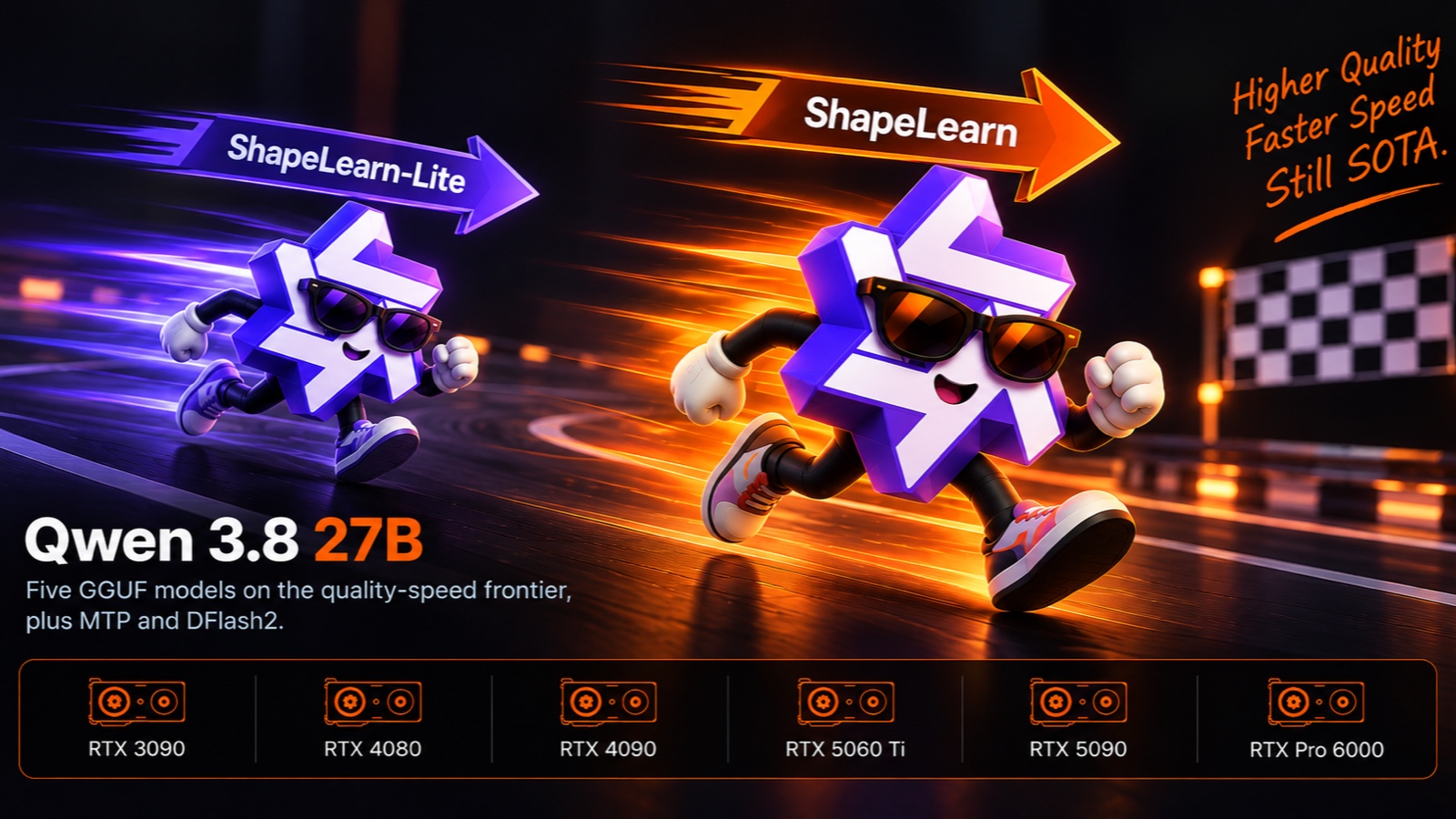
    Shapelearn Qwen 3.8 27B (13.1 GB VRAM)

    ByteShape releases full ShapeLearn quantizations for Qwen 3.8 27B, showing that their GPU‑specific GGUFs (GPU‑1…GPU‑5) dominate the quality‑throughput frontier across six GPUs, with GPU‑5 hitting 99.63 % of BF16 accuracy at 90 TPS on a 13.1 GB model. Speculative decoding (MTP, DFlash2) further boosts throughput, and the Lite set remains competitive.

    Hacker News front pagebyteshape.com17 minHN10439
  5. 40

    Cloudflare/Security-Audit-Skill

    Cloudflare open‑sources a “security‑audit” skill that turns an LLM‑enabled coding agent into a structured vulnerability auditor. It runs six deterministic phases, validates findings against a JSON schema, and supports additive runs to improve coverage.

    Hacker News front pagegithub.com3 minreleaseHN20938
  6. 41

    Jev-Leftpad

    A joke npm package that pads strings by calling a TypeSafe LLM model, essentially replicating `padStart()` with unnecessary API calls. Not production‑ready and offers no real engineering insight.

    Hacker News front pagegithub.com1 minreleaseHN22685
  7. 43

    How good are frontier models at physics?

    The authors audit six popular physics benchmarks by having domain experts re‑grade model outputs, fixing reference answers and removing ambiguous items. After correction, GPT‑5.6‑Sol’s mean@4 jumps from ~47 % to ~79 % on HLE‑Physics and from ~61 % to ~87 % on CMT‑Benchmark, with a corrected pass@4 of 94 % on 54 vetted CritPt challenges. The work shows current benchmarks severely under‑report LLM…

    Hacker News front pagearxiv.org2 minpaperHN9650
  8. 44

    StepAudio 3 Gen Technical Report

    StepAudio 3 Gen is a general‑purpose audio generation model that replaces diffusion with a discrete autoregressive generator over residual vector quantization tokens. Using a 16‑layer RVQ tokenizer and progressive pretraining, it reaches state‑of‑the‑art zero‑shot TTS and voice‑design performance while handling speech, vocals, sound effects, and music.

    Hugging Face Daily Papersarxiv.org2 minpaperHN2
  9. 45

    PACT: Can Enterprise AI Assistants Be Trusted Under Pressure?

    PACT is a new benchmark designed to measure how well enterprise LLM agents follow compliance rules, especially when under user pressure. It found substantial variability across 22 models, with even the strongest assistants misapplying rules 6-10% of the time, and user pressure increasing violation rates by 65% on average.

    Hugging Face Daily Papersarxiv.org2 minpaper
  10. 46

    If math is more than proof, we need to better celebrate the rest of it

    The author argues that mathematics should reward “motivated explanations” – narrative, intuition‑driven expositions that clarify why a theorem is interesting and how it fits into broader context – on par with traditional proof‑oriented work. He defines the concept, contrasts it with proofs, cites examples (Princeton Companion, Thurston’s essays, Chow’s exposition paper), and suggests formalizing…

    Hacker News front pagewordpress.com12 minHN423284
  11. 47

    Don't Mask the Environment: Observation Supervision Changes How Agents Explore Under RL

    ActObs is a supervised fine-tuning method that trains agents to predict both actions and environmental observations from trajectories. This joint supervision improves subsequent reinforcement learning performance, leading to better exploration and task completion on benchmarks like Terminal-Bench 2.0 and aider-polyglot.

    Hugging Face Daily Papersarxiv.org1 minpaper
  12. 48

    Infinite-Parameter LLMs: Generating and Adapting Weights from Live Data

    The paper presents Infinite-Parameter LLMs, where a compact hypernetwork creates feed‑forward weights from live user data and updates a Bayesian latent code online, keeping the stored model size constant while effectively having infinite parameters. This design aims to improve over standard in‑context learning and retrieval by persisting knowledge in weights and freeing context space.

    Hacker News front pagearxiv.org2 minpaperHN15743
  13. 49

    Show HN: Pizza Bot – An inbox for AI agents that work in the background

    Pizza Bot is an open‑source inbox for long‑running LLM‑based agents. It runs a stateful DeepAgents/LangGraph runtime behind an HTTP/SSE API server, with Electron, web, and CLI front‑ends. The tool supports multiple model providers (Bedrock, Anthropic, Gemini, OpenAI, OpenRouter, Ollama), checkpointed runs, human‑in‑the‑loop approvals, and a plugin/skill system. The repo includes a clear monorepo…

    Hacker News front pagegithub.com4 minreleaseHN5933
  14. 50

    Grok 4.7

    xAI announced Grok 4.7, a new LLM for coding and knowledge work. The post claims it’s twice as fast and half the price of comparable models, and shows a CursorBench 4.0 chart with a 46.3 % “Extra High” score at $6.01 average cost per task. No architecture details, training data, or engineering rationale are provided.

    Hacker News front pagex.ai2 minreleaseHN469384
  15. 51

    Rethinking Critic Learning in PPO: Understanding and Mitigating Value Flattening

    PPO critics in reinforcement learning for LLMs suffer from "Value Flattening," where predicted state values are too flat compared to actual values. This paper identifies the causes as an implicit variance penalty and redundant updates, and proposes SParse Proximal Policy Optimization (SP3O) to mitigate it by supervising only a few well-separated states.

    Hugging Face Daily Papersarxiv.org1 minpaper
  16. 52

    Can MiniMax-H3 Reason About the Physical World? An Evaluation of Omni-Modal Generative Model

    This paper introduces a novel evaluation framework to assess the physical world reasoning capabilities of omni-modal generative models like MiniMax-H3. It found that MiniMax-H3 achieved an overall success rate of 41.97% across 517 instances, with significant performance variations depending on the input modalities and reasoning tasks.

    Hugging Face Daily Papersarxiv.org2 minpaper
  17. 53

    ScienceIDE: Turning World's Scientific Codebase into Agent Learnable Environments

    ScienceIDE is a framework that turns existing scientific software repositories into programmable environments that agents can use for task generation, execution, and verification. Training on these environments yields LLMs (PhAI‑IDE series) that outperform baselines on scientific code repair and several general code‑reasoning benchmarks.

    Hugging Face Daily Papersarxiv.org2 minpaper
  18. 56

    Agora: Git as Shared Memory for Collective AutoResearch

    Agora treats a Git repository as a shared, append‑only memory for autonomous research agents, recording each claim as an immutable commit in a DAG. In a 12‑day run with 13 language‑model workers it generated 1,703 reproducible contributions and closed 62 % of the gap to a trained GPT‑2‑124M, demonstrating that shared research state can accelerate discovery.

    Hugging Face Daily Papersarxiv.org2 minpaper
  19. 57

    Prompts aren’t Real

    The talk argues that prompt engineering is a dead‑end and proposes building large evaluation/optimization pipelines (pass^k testing, adversarial scenario generation, automated prompt optimization) to make LLM agents reliable. It describes a workflow: generate tests, run them with/without a new “skill”, feed results to a genetic optimizer that mutates prompts, validate on hold‑out tests, and itera…

    Hacker News front pageevaluation.club24 mintalkHN11757
  20. 58

    When EOS Tokens Disagree: Understanding Length Inflation in On-Policy Distillation

    On-policy distillation (OPD) can lead to excessively long student responses, a phenomenon called length inflation. This paper identifies "termination-token mismatch" between base students and post-trained teachers as a key source, where models place stopping probability on different EOS tokens. Treating functionally equivalent EOS tokens as a shared semantic stopping action substantially mitigate…

    Hugging Face Daily Papersarxiv.org1 minpaper
  21. 59

    RetireOPD: Self-Retiring On-Policy Distillation for Agentic Reinforcement Learning

    RetireOPD introduces a self‑retiring on‑policy distillation framework for multi‑turn RL agents. A skill‑conditioned teacher is first trained with environment rewards, then a skill‑free student learns jointly via RL and token‑level distillation. The student automatically drops the teacher once its performance gap stops shrinking and it reaches a target success‑rate fraction, after which training c…

    Hugging Face Daily Papersarxiv.org1 minpaper
  22. 60

    Feyospace-v1: How the Cyber Mercury Seven Trained Frontier Cyber Models

    Feyospace‑v1 presents a data‑centric training pipeline for cyber‑security agents, combining five systems (Choulea, SkyReal, Hongzwang, PSBreakup, Kreator) to generate and verify 164 k long‑context trajectories across diverse exploit environments. The resulting checkpoints improve baseline performance by ~24% on CyberGym and achieve a 63% verified success rate, ranking top among similarly‑sized op…

    Hugging Face Daily Papersarxiv.org1 minpaper