proomt

Search

Search posts, papers, and topics

performance

RSS
  1. 32

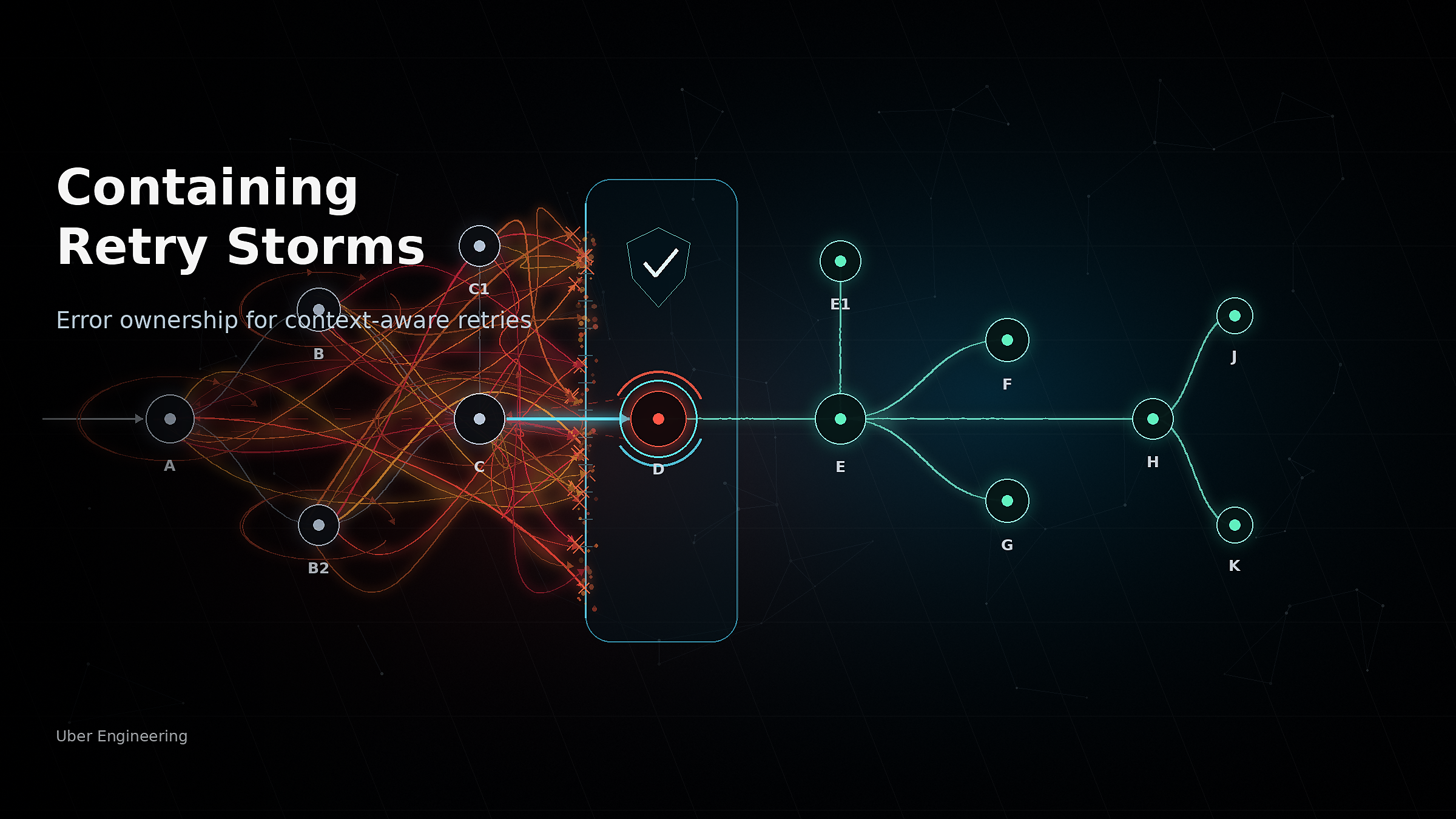
    How Uber Protects Against Retry Storms

    Uber developed a context-aware mechanism to prevent retry storms in deep microservice dependency chains. It introduces "error ownership" where services claim errors they originate and unclaim errors they propagate, allowing upstream callers to make informed retry decisions and avoid amplifying load on already struggling services.

    Hacker News front pageuber.com12 minHN11949
  2. 33

    Accurate Models of AMD Matrix Cores

    The authors reverse‑engineer AMD’s CDNA matrix cores, build per‑architecture MATLAB models that match hardware bit‑for‑bit on 10 M random tests, and use them to compare AMD vs NVIDIA tensor‑core accuracy.

    Hacker News front pagearxiv.org2 minpaperHN7911
  3. 35

    A custom virtual machine for the Stars! 4X game

    Stars!VM is a 32‑bit Windows executable that embeds a custom 80286 emulator and a Win16‑to‑Win32 bridge to run the 1995 4X game Stars! without any external emulators. The author adds differential fuzzing, hot‑routine patching, I/O buffering and asset compression, achieving about a 2× speedup in turn generation.

    Chris Wellonsnullprogram.com5 minHN8422
  4. 36

    Grok 4.7

    xAI announced Grok 4.7, a new LLM for coding and knowledge work. The post claims it’s twice as fast and half the price of comparable models, and shows a CursorBench 4.0 chart with a 46.3 % “Extra High” score at $6.01 average cost per task. No architecture details, training data, or engineering rationale are provided.

    Hacker News front pagex.ai2 minreleaseHN469384
  5. 39

    Video DeltaNet: A Video-Native Hybrid Attention for Livestream Video Generation

    Video DeltaNet (VDN) replaces full‑softmax attention in video diffusion models with a hybrid: per‑frame local Softmax for fine detail and a bidirectional linear memory (Video Delta Attention) for long‑range context. A teacher‑alignment schedule injects the linear branch into a pretrained MiniMax H3 model, preserving Softmax for text/audio streams. On eight NVIDIA B200 GPUs VDN‑H3 denoises a 14.3‑…

    Hugging Face Daily Papersarxiv.org1 minpaper
  6. 40

    Fathom: Per-Query Read Depth for Sparse Decoding over Offloaded KV Caches

    Fathom introduces a per-query read depth mechanism for sparse decoding over offloaded KV caches, allowing each query to adaptively decide how many bits of each key channel to read. This method significantly speeds up decoding for large language models with long contexts by reducing host memory traffic, achieving 1.67x faster GPU decoding on Qwen3-8B at one million tokens.

    Hugging Face Daily Papersarxiv.org1 minpaper
  7. 42

    Size-Specialized Memory Allocation

    Go 1.27 adds a set of span‑class‑specific malloc functions for allocations ≤ 80 bytes. By generating a tiny, constant‑size allocator per span class the runtime can inline size‑dependent work (e.g. zero‑clear) and skip span‑class lookup, yielding 20‑30 % faster small allocations and ~1 % overall speed‑up for allocation‑heavy programs. The implementation is generated automatically via an AST inline…

    The Go Bloggo.dev7 minHN315
  8. 43

    Migrating the GitHub Copilot runtime to Rust, using Copilot

    The Copilot agent runtime was rewritten from a 130‑k‑line TypeScript/Node.js codebase into a native Rust library (~830 k lines of Rust) to reduce startup latency, memory use, and improve reliability. The migration was done incrementally (in‑place) across 128 PRs, with AI‑generated code handling most of the work. The new runtime exposes a C ABI for in‑process embedding by all six Copilot SDK langu…

    GitHub Oldgithub.blog65 minHN188
  9. 44

    When2Think: Learning Difficulty-Aware Length Control for Efficient Hybrid Reasoning Models

    When2Think introduces a post‑training framework that lets a large reasoning model decide per‑instance how much reasoning depth to allocate, using difficulty‑aware reward shaping (IDAC) and verifier rewards. It cuts token usage by ~28% while boosting Pass@3 by 10% on AIME24 and reaches 40% Pass@3 on AIME25, outperforming compression and routing baselines.

    Hugging Face Daily Papersarxiv.org1 minpaper
  10. 45

    The Other Half of the Memory Wall: Serving 35B MoEs from SSD with Trained Routing Prediction

    The paper presents Edge0, a streaming MoE inference engine that predicts the next layer's routing one token ahead, allowing expert weights to be fetched from SSD while compute proceeds. This enables a 35 B‑parameter MoE to run on a single 24 GB machine at ~20 tokens/s using only ~3 GiB of active memory and with near‑teacher accuracy.

    Hugging Face Daily Papersarxiv.org1 minpaper
  11. 46

    Sample Count Is Not Enough: Candidate-Generation Strategy Shapes the Energy and Performance of LLM Test-Time Scaling

    Increasing the number of LLM candidates (N) improves reasoning accuracy, but the way those candidates are generated (batch size vs sequential calls) dramatically affects latency, GPU‑hours, and energy. On A100 GPUs, eight serial 1‑candidate calls consume ~5× more energy and take ~6× longer than a single 8‑candidate batched call, even though total candidate count is identical. The authors recommen…

    Hugging Face Daily Papersarxiv.org2 minpaper
  12. 47

    VC-Attention: Value Smoothing and Softmax Casting for Low-bit Attention

    VC-Attention introduces a training‑free low‑bit attention pipeline for diffusion transformers. It smooths value tensors via lightweight online clustering (V‑Smooth) and quantizes only the residual after subtracting block means, restoring the mean from the softmax row sum. It also replaces the FP32 softmax exponential with a fused FP8 cast (ExpCast‑FP8) that maps log‑scores directly to E4M3 probab…

    Hugging Face Daily Papersarxiv.org1 minpaper
  13. 48

    Textbook review: Is Parallel Programming Hard, And, If So, What Can You Do About It?

    A detailed, personal review of Paul McKenney’s free online textbook on parallel programming. The author, coming from a TLA⁺/distributed‑systems background, finds the early chapters excellent for building intuition about CPU caches, memory ordering, and false‑sharing, but notes gaps (e.g., shallow coverage of C++11 atomics and MESI). The review is concrete, cites specific chapters, and offers prac…

    Lobstersahelwer.ca8 minlobste.rs21
  14. 49

    SiliconBench: Speed, Memory, and Fidelity for LLM Serving on Unified-Memory Desktops

    SiliconBench benchmarks nine Apple‑Silicon LLM serving engines on unified‑memory desktops, measuring speed, memory usage, and output fidelity across Qwen3, Qwen3.5, and Gemma‑4 models. It finds vllm‑metal doubles throughput at modest concurrency, memory budgets often fail to preserve headroom, and only three stacks satisfy all fidelity and model‑coverage requirements, with tensor‑parallel scaling…

    Hugging Face Daily Papersarxiv.org1 minpaper
  15. 50

    How Lossless Is Lossless Speculative Decoding? The Role of Numerical Precision in Orthrus

    This paper investigates the "lossless" claim of Orthrus, a hybrid architecture for accelerating LLM inference. It finds that under BF16 precision, Orthrus diverges from the exact autoregressive output trajectory in over 50% of cases, though FP32 maintains exact matching. Despite BF16 divergence, downstream task performance was not systematically degraded.

    Hugging Face Daily Papersarxiv.org1 minpaper
  16. 51

    Jev is the fastest-adopted model in AI Gateway history

    Vercel reports that the Jev decision model was adopted by 13% of paid teams within its first day, outpacing prior model launches. Jev claims to be up to 194× faster and 445× cheaper than general‑purpose LLMs while returning structured, probabilistic decisions.

    Vercelvercel.com1 minHN21
  17. 52

    TypeSafe AI's Jev now available on AI Gateway

    Vercel AI Gateway now offers Jev, a probabilistic decision model that returns typed choices, scores, and booleans instead of raw text. TypeSafe AI reports it runs up to 193× faster and 445× cheaper than standard LLMs, exposed via the experimental evaluate API in AI SDK 7.

    Vercelvercel.com2 minrelease
  18. 53

    AI Changed How Spotify Builds. What We Learned (and Fixed) About Quality at Higher Velocity

    Spotify’s AI‑assisted development doubled change volume, exposing gaps in alerting, capacity planning, fleet‑update safety, and mobile quality signals. The team added end‑to‑end monitoring, priority‑based tiering, stronger rollback/observability, and expanded edge capacity. Data shows AI‑generated code isn’t a direct incident cause, but verification pipelines must scale with velocity.

    Spotifyatspotify.com7 minpostmortemHN52
  19. 55

    OpenTelemetry everywhere: Migrating a metrics platform at scale

    Atlassian replaced its decade‑old gostatsd‑based metrics pipeline with a fully OpenTelemetry‑based stack by keeping the StatsD‑UDP contract on the client side and swapping in purpose‑built OTel Collector distributions for collection, ingest, aggregation, and forwarding. The migration was done incrementally, saved ~3.9% CPU per service, cut sidecar cost ~30% fleet‑wide, halved aggregation CPU, and…

    CNCFcncf.io6 minHN1
  20. 57

    tokenizers v1: encode, decode and scaling, measured

    Hugging Face has released `tokenizers` v1, a major performance update that achieves 3-30x faster encoding than v0.23 while maintaining identical output and API compatibility. Key optimizations include a SIMD-accelerated splitter, a thread-local word cache, and an allocation-free BPE merge loop, ensuring tokenization doesn't bottleneck ML workflows.

    Hugging Facehuggingface.co10 min
  21. 59

    Open-weight models take 56% of token volume, Astra doubles Fable 5.1 spend

    Vercel’s September AI Gateway Production Index shows open‑weight models processing 56% of token volume (up from 7% in Dec 2025) while accounting for only 14% of spend. Token price fell 23.2% month‑over‑month. Anthropic’s Opus 5 captured 22.5% of spend, overtaking Fable 5 which dropped to 4.9%. OpenAI’s new GPT‑6 Astra grabbed ~7.7% of total gateway spend in its first 12 days, more than double Ant…

    Vercelvercel.com6 minHN2
  22. 60

    Shared Selective Persistent Memory for Agentic LLM Systems

    Apple proposes a memory architecture for agentic LLMs that selectively persists reusable context (specs, schemas, configs, constraints) across sessions and users. Shared workspaces with role‑based access and a zero‑token data‑refresh mechanism cut token usage by 97×, reduce task time by 14×, and raise task‑completion rates to 96% versus 71%‑79% for baselines.

    Apple Machine Learning Researchapple.com1 minpaper