proomt

Search

Search posts, papers, and topics

New

  1. Introducing System One Models and Jev

    TypeSafe AI announced its first “System One” model, Jev, a non‑text‑generating LLM that outputs type‑safe structured decisions with calibrated probabilities. It claims 40‑200× lower latency (70‑500 ms) and 100‑500× lower cost versus frontier LLMs, no hallucinations, and parallel sampling. The post includes a side‑by‑side demo, a custom “workflow” benchmark comparing Jev to GPT‑5.6/6 and other mod…
    Hacker News front pagetypesafe.ai9 minHN1824480lobste.rs26
  2. Learning to solve hard problems in RL for LLMs by never giving up

    The post introduces the *Matthew Effect* in RL‑fine‑tuning of LLMs—performance gains concentrate on tasks the model already solves— and proposes *Never Give Up* (NGU), an adaptive sampling scheme that uses a small k for easy prompts and retries hard prompts with a high‑probability “never give up” loop. Experiments on math (AIME, GSM8k), code (Manufactoria), and larger‑scale setups (DeepScaler) sh…

    Hacker News front pagegithub.io11 minHN1179
  3. Swift 6.4 Released

    Swift 6.4 adds Swift Build as the default SPM build system, stabilizes Subprocess (1.0), expands C++/Java interop, boosts WebAssembly performance (up to 40×), introduces new language features (optional some/any, @diagnose, module selectors, async defer, cancellation shields), adds non‑copyable array types, SBOM generation, and broader IDE support.

    Lobstersswift.org7 minreleaseHN12663lobste.rs23
  4. Kubernetes v1.37: Pod-Level Resource Managers graduated to Beta

    Kubernetes v1.37 adds Pod‑Level Resource Managers to beta (off by default). The feature lets Kubelet’s Topology, CPU, and Memory managers consume pod‑level `.spec.resources` to reserve exclusive NUMA‑aligned CPUs/memory for primary containers while sidecars share a pod‑isolated pool. A new PodResources gRPC API now reports `cpu_ids` and `memory` per pod. Enable via the `PodLevelResourceManagers`…

    Kuberneteskubernetes.io2 min
  5. Why I'm still bearish on LLMs after Navier-Stokes

    The author argues that despite headline successes (e.g., Navier‑Stokes proof, security exploits), current frontier LLMs still require heavy human oversight and rigorous specifications that are costly to produce. Reward‑hacking, narrow generalization, and the need for domain‑expert spec writing limit autonomous deployment to only a few niche domains (high‑failure‑cost work, tightly defined tasks,…

    Hacker News front pagedank.systems5 minHN487644lobste.rs49
  6. This cyberdeck is a… puppet?

    A unique cyberdeck was built by Natasha Dzurny, housed inside an "Avenue Q"-style puppet, featuring an Arduino UNO Q, a mini Bluetooth keyboard, and a 5-inch HDMI display. This project showcases extreme personalization in hardware design, integrating standard electronics into a custom, interactive puppet enclosure.

    Arduino Blogarduino.cc1 min
  7. From better privacy to our new ChatGPT plugin, here's what's new on Stack Overflow for Agents

    Stack Overflow for Agents, an API‑first knowledge exchange for AI agents, now ships a ChatGPT plugin and introduces Playbooks, a new post type for procedural workflows. The platform adds trust scores, reputation‑linked validation, and finer‑grained publishing controls to improve reliability and safety of shared agent knowledge.

    Stack Overflowstackoverflow.blog4 minrelease
  8. From Megawatts to Tokens: How NVIDIA Maximizes AI Factory Production

    NVIDIA’s DSX platform lets AI data‑centers shift workloads in response to grid signals, squeezing ~24% more token throughput (4 M→5 M tps) and ~23% better performance‑per‑watt on a fixed megawatt budget. The first production demo used Emerald AI’s Conductor to drop a 4 MW load to 3 MW in under a minute without interrupting high‑priority jobs. DSX MaxLPS reallocates headroom across HGX B200 server…

    Nvidianvidia.com5 min
  9. How energy teams turn theft detection into governed action with Genie and AI business processes

    Databricks shows how to turn energy‑theft ML scores into a governed, end‑to‑end workflow using a Databricks App, Lakebase for live case state, Unity Catalog for data governance, and Genie One for natural‑language executive reporting. The pattern lets utilities act on alerts faster while staying compliant, and can be reused for other fraud‑type use cases.

    Databricksdatabricks.com6 min
  10. What I learned organizing KCD Lima 2026

    KCD Lima 2026 drew 2,244 registrations (900+ attendees), 60 speakers, and 11 sponsors, marking 75% growth over 2025. The organizer shares hard data and concrete takeaways: budgeting across currencies, vendor onboarding, venue layout, and the need for better coffee capacity, session timing, pre‑registration, and gender balance. The post also highlights the community profile (45% from finance, 15%…

    CNCFcncf.io7 minpostmortem
  11. Your Agent Aced the Task. Will It Do It Again?

    The post introduces the Consistency Analyzer, a cheap black‑box diagnostic that flags flip‑prone decision steps in LLM agent traces, and shows how feeding the resulting consistency guidelines back into ALTK‑Evolve halves the gap between mean success and all‑run success (Pass⁵) on the AppWorld benchmark without hurting average accuracy.

    Hugging Facehuggingface.co8 minHN21
  12. Introducing Filestore agent volumes: fully managed storage for agent workspaces

    Google Cloud adds Filestore agent volumes, a fully‑managed, elastic file‑system that automatically provisions isolated POSIX workspaces for GKE‑based AI agent sandboxes. Volumes attach in milliseconds, support RWX with file‑level locking, and charge only for used capacity with automatic tiering, aiming to cut cold‑start latency and storage waste for large‑scale agent fleets.

    Google Cloud Bloggoogle.com4 min
  13. Best practices for handling cloud reliability incidents

    The article outlines a structured Verify→Investigate→Report→Resolve→Review workflow for GCP reliability incidents and stresses pre‑incident preparation across design, data, playbooks, and training. It lists concrete tools (Cloud Logging, Service Health, Gemini Assist) and reporting steps to help engineers reduce outage impact.

    Google Cloud Bloggoogle.com11 min
  14. Scaling Telco Autonomy: Leveraging GNNs with Distributed GraphFlow

    Google Cloud’s blog introduces Distributed GraphFlow (DGF), an open‑source Python library for building and scaling Graph Neural Networks (GNNs) on a Spanner‑backed digital twin of telecom networks. The post outlines the three‑layer architecture (digital twin on Spanner Graph, ML layer with DGF, AI agents) and highlights DGF’s high‑level API (5‑line example) and low‑level primitives, but provides…

    Google Cloud Bloggoogle.com3 min
  15. Agent Substrate brings high-density, scalable, trusted infrastructure to GKE

    Agent Substrate is an open‑source runtime for AI agents that runs on GKE. It uses Cloud Hypervisor microVMs or gVisor sandboxes to give kernel‑level isolation, a custom control‑ and data‑plane that can suspend/resume agents in <500 ms, and a “zero‑idle” model that packs >1 000 dormant agents per host (≈10× density vs. containers). GKE integration adds custom ComputeClasses, spot/on‑demand pools,…

    Google Cloud Bloggoogle.com6 min
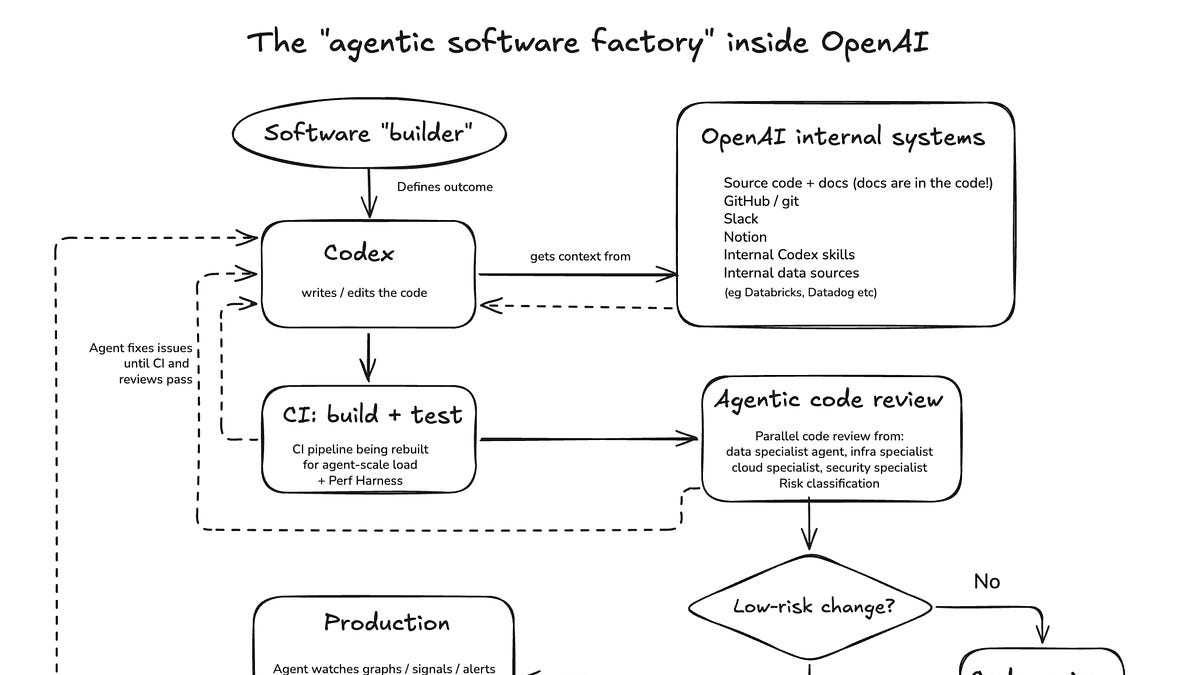
  16. Inside OpenAI’s agentic software factory

    OpenAI has internalized Codex and ChatGPT Work as a universal coding agent, achieving >90% adoption across the company and reshaping tooling, CI/CD load, and engineering roles. The shift has forced a new agentic software factory, massive infra scaling, and a rethink of IDEs, PRs, and code reviews.

    The Pragmatic Engineerpragmaticengineer.com15 minHN1
  17. Grand MS-DOS Gaming General MIDI Showdown

    The author records 46 classic DOS game soundtracks on seven MIDI modules (Roland SC‑55, SC‑VA, Yamaha MU80, S‑YXG50, etc.), shares 322 lossless recordings plus REAPER project files, and documents a repeatable workflow for extracting MIDI from DOSBox, cleaning it, and rendering audio on hardware and software synths.

    Hacker News front pagejohnnovak.net27 minHN9520