proomt

Search

Search posts, papers, and topics

New

  1. Do LLMs Have the Memory of a Goldfish?

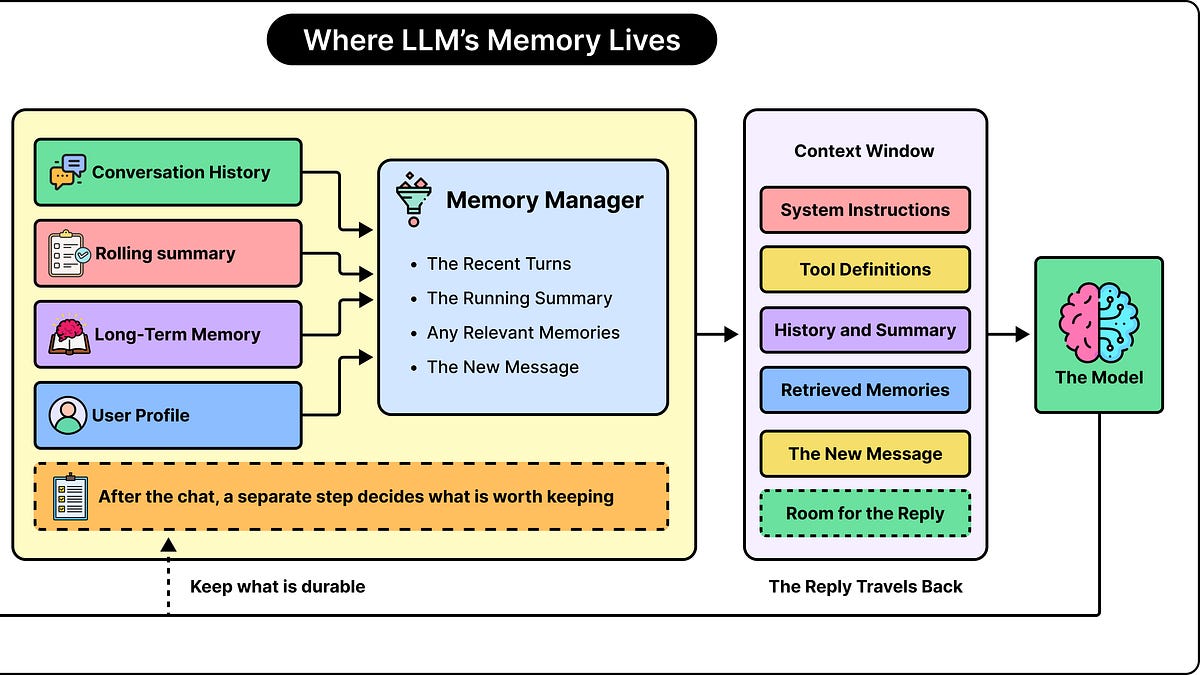
    The article explains that LLMs don’t have persistent personal memory; all “memory” is supplied by the surrounding application via the context window, summaries, or external storage. It outlines the distinction between trained weights, working‑memory (token context), and persistent application memory, shows how to construct API calls to preserve conversation state, and discusses the cost and laten…

    ByteByteGobytebytego.com12 min
  2. Show HN: Pizza Bot – An inbox for AI agents that work in the background

    Pizza Bot is an open‑source inbox for long‑running LLM‑based agents. It runs a stateful DeepAgents/LangGraph runtime behind an HTTP/SSE API server, with Electron, web, and CLI front‑ends. The tool supports multiple model providers (Bedrock, Anthropic, Gemini, OpenAI, OpenRouter, Ollama), checkpointed runs, human‑in‑the‑loop approvals, and a plugin/skill system. The repo includes a clear monorepo…

    Hacker News front pagegithub.com4 minreleaseHN5933
  3. From error mitigation to fault-tolerant quantum computing

    IBM’s blog outlines a practical continuum from quantum error mitigation to fault‑tolerant error correction, highlighting hybrid spacetime codes that achieve ~10× effective error‑rate reduction (64 logical qubits on 76 physical qubits) and a 63× sampling‑overhead cut versus pure mitigation. It describes how post‑selected QEC combined with probabilistic error cancellation, dynamic circuits, and a n…

    IBM Researchibm.com10 min
  4. Laravel MCP 1.0 Is Released

    Laravel MCP 1.0 ships with the 2026-07-28 protocol, adding searchable tool catalogs, cache hints, stateless request handling, and PKCE‑required OAuth with client‑metadata support. The release includes migration guidance and new headers for versioned RPC calls.

    Laravellaravel-news.com3 minrelease
  5. Automating EDA With fg-data-profiling

    The Real Python course shows how to automate exploratory data analysis using the fg-data-profiling library. It walks through building, exporting, time‑series profiling, and comparing reports with concise code examples.

    Real Pythonrealpython.com2 min
  6. Laravel Vet: Review Composer Code Before It Installs

    Laravel Vet is a Composer plugin that intercepts installs/updates, shows the diff of each package, and lets you approve changes manually or via an LLM‑based coding agent. Trusted packages are recorded in a `vet.json` with a content hash, so future updates only prompt for new changes. The tool exits with an error on untrusted code, making it CI‑friendly, and works with any PHP project using Compos…

    Laravellaravel-news.com4 min
  7. Replica-aware routing public beta

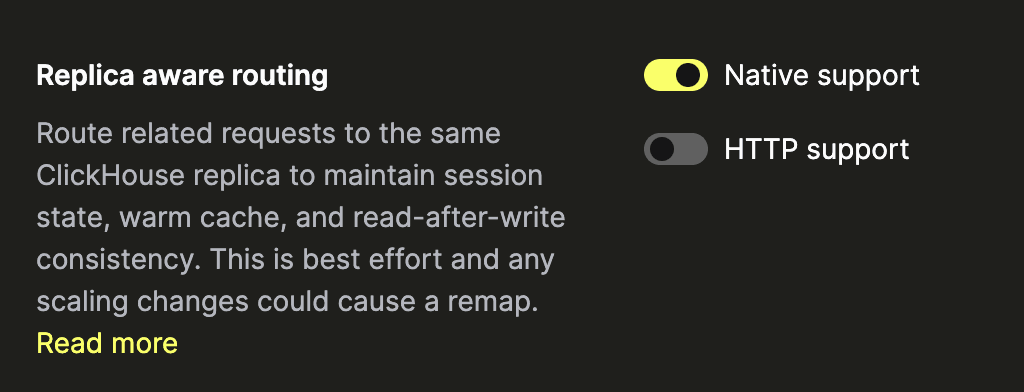
    Replica‑aware routing (public beta) lets ClickHouse Cloud users pin a query stream to a specific replica by sending a custom header (HTTP) or overriding the TLS SNI (native). The proxy (Envoy) hashes the tag and consistently forwards all requests with the same tag to that replica, giving read‑after‑write consistency for temporary tables, session objects, and warm replica caches. Stickiness is bes…

    ClickHouseclickhouse.com6 min
  8. How I Wrote a Forth (Without Knowing How)

    The author details building MoonForth, a Forth interpreter written in C that leverages Lua's C API for stack manipulation and word storage. The process was surprisingly straightforward, reinforcing the idea that Forth "writes itself" by iteratively filling missing functionality.

    Lobstersvtrlx.ca9 minHN2lobste.rs9
  9. Building a Reliable Script-to-Video Pipeline for Modern Web Applications

    A practical guide to building a reliable, observable script‑to‑video pipeline. It advocates a staged architecture (scene manifest → asset generation → voice → rendering → encoding), validates AI‑generated JSON with Zod, persists project and scene state, uses explicit workflow states, runs heavy work in background queues, limits concurrency, and stores voice, captions, and assets separately to ena…

    SitePointsitepoint.com11 min
  10. IBM Built the Cold War’s Most Powerful Code Breaker for the NSA

    IBM’s Harvest (IBM 7950) was a 1960s NSA‑dedicated streaming coprocessor attached to an IBM Stretch mainframe. It ran up to 200× faster than contemporary machines, used a custom bit‑addressable memory model, pipelined parallel streams (P, Q → R), and introduced the world’s first automated tape library. IBM also created a domain‑specific language, Alpha, for cryptanalytic programmers. The article…

    Lobstersieee.org13 minHN10125lobste.rs8