proomt

Search

Search posts, papers, and topics

New

  1. Build, deploy, and operate with coding agents on Render

    Render adds OAuth‑based MCP access, expands its “skills” library to 20+ actions, and upgrades the CLI to manage full service lifecycles, enabling coding agents (Cursor, Claude, Codex, ChatGPT) to trigger deploys, adjust plans, and spin up disposable PR environments via structured JSON/YAML commands.

    Renderrender.com4 min
  2. How we tracked down a 16-year-old SQLite bug

    Tailscale experienced 19 SQLite database corruptions over six months due to a 16‑year‑old bug in SQLite’s WAL checkpoint logic. The single‑writer, Go‑driven shard architecture forced them to add forensic telemetry, a transaction‑logging replay pipeline, and work directly with SQLite core developers to isolate and fix the issue, dramatically reducing downtime.

    Tailscaletailscale.com14 minpostmortemHN1223239
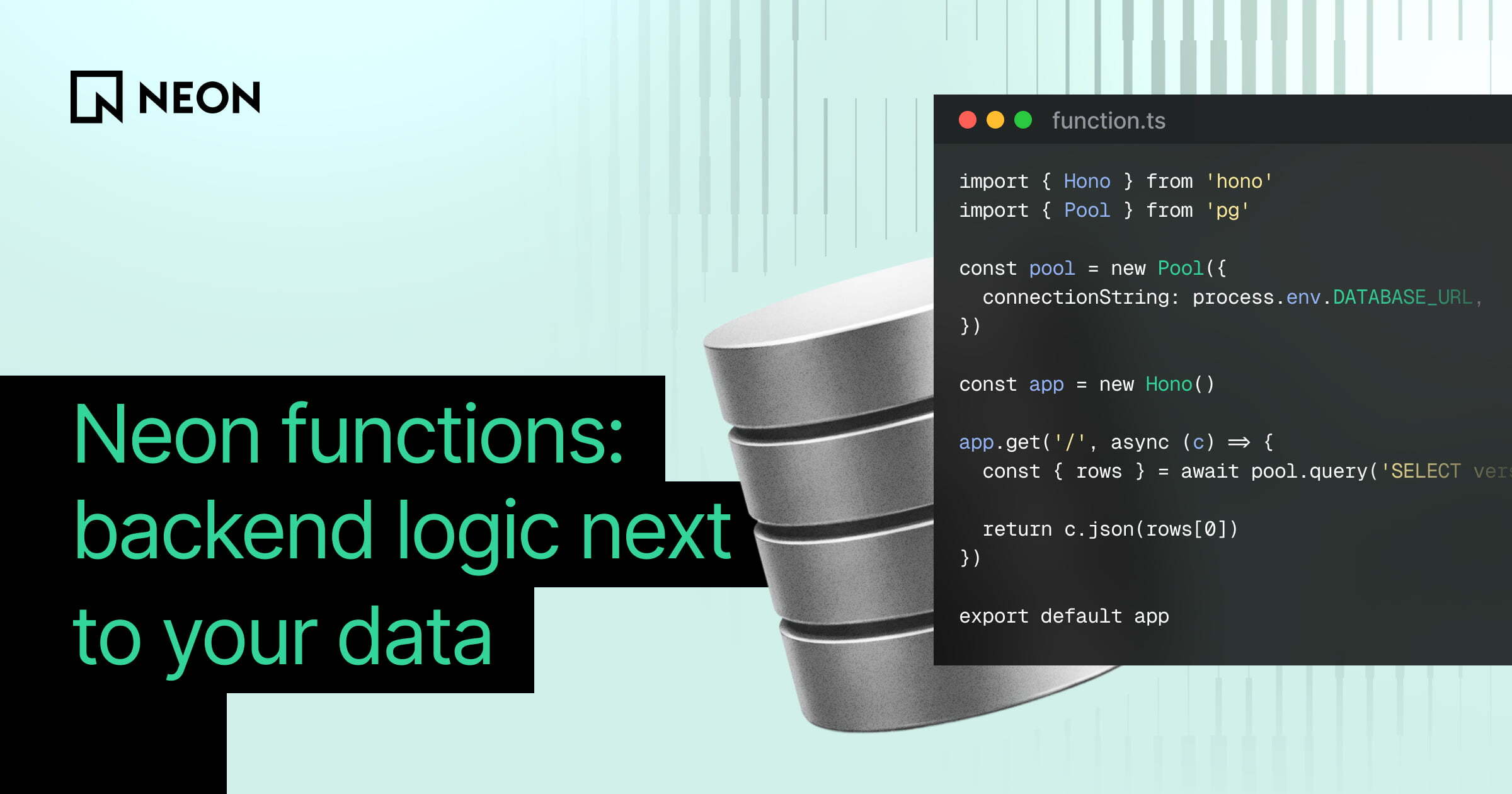
  3. Neon Functions: backend logic next to your data

    Neon Functions are server‑less Node.js 24 compute that run on the same branch and region as Neon’s Lakebase Postgres, giving low‑latency DB access, long‑running connections for agents/WebSockets, automatic credential injection, and branch‑aware deployment via neon.ts. They’re meant for data‑adjacent backend logic, not full‑stack hosting, and future plans include native cron and event triggers.

    Neonneon.com5 min
  4. Label your agent steps

    This post demonstrates how to use Temporal's `summary` fields for Activities, Timers, and Workflows to enhance observability. These labels make it significantly easier to debug and understand the execution flow of complex, especially agentic, workflows directly in the Temporal UI without needing to inspect full payloads.

    Temporaltemporal.io4 min
  5. Chaining Activities — from text to vectors

    This post details how Temporal Activities orchestrate an RAG pipeline, from text embedding to vector storage, ensuring PII compliance and idempotency. It covers using an on-premise embedding model, caching vectors in Redis, and upserting to Pinecone with robust retry mechanisms.

    Temporaltemporal.io5 min
  6. The Real Cost of a Homegrown Feature Flag System

    Home‑grown feature flag systems look cheap until maintenance, governance, and scaling costs explode, especially as AI‑accelerated development creates more flags faster. Buying a managed solution offloads engineering effort, adds audit trails, and scales with multiple teams.

    Codeshipcloudbees.com6 min
  7. New in Render: Do more with your coding agent

    Render added browser‑based MCP login and a suite of agent‑friendly actions (service creation, DB queries, log inspection, deploy triggers) plus CLI JSON/YAML output. Build times dropped 60% for Dockerfiles and 25% for Node.js, and new OIDC, SCIM, and logging integrations tighten security and observability.

    Renderrender.com2 minrelease
  8. Electric is joining team Neon at Databricks

    Databricks announced that the Electric team, creators of the WASM‑compiled Postgres engine PGlite and a real‑time sync layer, is joining Neon. The integration adds an embedded Postgres database and continuous sync primitive to Neon’s platform, aiming to lower compute costs for small, agent‑driven apps.

    Neonneon.com3 minHN82
  9. Desktop Calendar: A Design Journey

    The Thunderbird Automation Team outlines the redesign of the desktop calendar UI, moving to a three‑pane layout (grid, navigation bar, collapsible sidebar) and updating dialogs for better visual hierarchy. Community feedback via surveys and TopicBox shaped the direction, and the new design will be rolled out incrementally for further testing.

    Mozilla Automation Teamthunderbird.net5 minHN7327
  10. Upcoming changes to Workflows pricing

    Render is moving Workflows to a new Flex compute plan that charges per‑second usage at $0.20/CPU‑hour and $0.05/GB‑hour, adds per‑workflow resource limits, and starts billing task state retention at $0.25/GB. Existing Starter/Standard workloads will auto‑migrate on Sep 1, with most users seeing lower costs.

    Renderrender.com2 minrelease
  11. AI Model Drift: How to Keep Models Reliable

    Honeycomb’s guide explains the four main kinds of AI model drift (data, concept, upstream, and prompt/embedding/output), why drift is hard to spot in LLM‑based systems, and how to set up baselines and observability signals (distribution stats, evaluation scores, user feedback, retry rates, etc.) to catch it early.

    Honeycombhoneycomb.io9 min
  12. Cylic trait implementations: motivation

    The post introduces the problem of cyclic trait implementations in Rust, showing how allowing certain cycles could enable “perfect derive” that derives traits based on field types rather than generic bounds. It also explains why naïvely accepting any cycle is unsound, especially with supertraits, and outlines the need for a principled solution.

    Mozilla Automation Teamsmallcultfollowing.com9 minHN1
  13. Stripe: An orchestration layer, not a platform

    Stripe Projects is an orchestration layer that lets developers provision accounts, services, and resources across multiple SaaS providers via a single CLI, using a shared payment token to centralize billing. It abstracts three core objects—account, service, resource—and defines a simple lifecycle for provisioning, credential rotation, and de‑provisioning.

    Renderrender.com3 min
  14. Full Sandbox egress firewall now available on Hobby plan

    Vercel added full Sandbox egress firewall capabilities to the Hobby plan, letting you define allow/deny network policies and attach secrets to outbound requests. You can configure policies via code or the Sandbox CLI, reducing data exfiltration risk for low‑cost projects.

    Vercelvercel.com1 minrelease
  15. Vercel Sandbox now supports Devin Outposts

    Vercel Sandbox adds support for Devin Outposts, letting each AI agent session run in an isolated microVM with snapshot state and firewall controls. Teams can deploy via a provided quickstart and get automatic credential handling.

    Vercelvercel.com1 minrelease
  16. Next.js 16.3 support on Vercel

    Vercel added full support for Next.js 16.3, bringing leaner prefetching, immutable static assets, and faster route metadata handling. Early adopters see up to 45% fewer prefetches, 24% less static traffic, and roughly 2× faster routing at scale.

    Vercelvercel.com4 min
  17. Give your eve agent a browser

    Vercel released the @agent-browser/eve extension, giving Eve agents full browser automation capabilities inside their sandbox. It adds installable tools for navigation, interaction, and screenshots, with domain allowlists and credential protection.

    Vercelvercel.com1 minrelease
  18. Why Codename One Is Moving Beyond Maven Central

    Codename One is moving its Maven artifacts from Sonatype’s Maven Central to a self‑hosted Cloudflare R2 bucket. Phase 1 reduces release payloads (from 229 MB to 77 MB) by dropping fat‑JARs and freezing stable deps, adds dual‑publish, and updates generated POMs to include a custom repository for both dependencies and plugins. After a three‑week observation window (ending Aug 28 2026) new releases…

    CodeName Onecodenameone.com7 min
  19. How Factory scaled its cloud backend to one billion monthly requests on Vercel

    Factory runs its entire SaaS backend on a single Next.js app deployed to Vercel, handling about a billion API requests per day with 350 ms p95 latency. They achieve this with Vercel’s Fluid compute to avoid cold starts, built‑in observability and WAF for security, and internal automation (“Droids”) that let non‑engineers deploy tools without extra infrastructure.

    Vercelvercel.com4 min
  20. Share Vercel Container Registry repositories across teams

    Vercel added read‑only sharing of Container Registry repositories across teams, allowing any team to pull images from a shared repo. The sharing is managed through the dashboard or Vercel CLI and can be used in Vercel Sandbox with a team‑scoped image reference.

    Vercelvercel.com1 minrelease