proomt

Search

Search posts, papers, and topics

All posts

Hacker News front pageMark Seemann8 min readintermediate

Learning Programming in an Age of LLMs

Summary

Mark Seemann reflects on learning to program in the era of LLMs, sharing personal history, doubts about AI‑driven development, and advice to focus on fundamentals and ask verifiable questions of models.

  • LLM assistance can hide gaps in understanding; when problems arise the lack of depth becomes painful.
  • Understanding the layer directly below (and above) your current abstraction remains a solid rule of thumb for troubleshooting.
  • Use LLMs for falsifiable, concrete questions (e.g., code refactoring) rather than open‑ended advice.
  • Fundamental knowledge (data structures, language semantics, OS concepts) still provides long‑term value, even if AI can speed up some learning.

As AI‑assisted coding becomes mainstream, engineers must balance productivity gains with the risk of building systems they cannot fully comprehend, impacting maintainability and career resilience.

4/10

Related reading

  1. Presentation: Complexity and Creativity in Software Engineering

    Phillip Mortimer argues that AI‑generated code makes all software effectively "write‑only" due to volume, and proposes managing this by treating tests as the sole specification, automating code reviews with LLMs, and decoupling intent from implementation.

    InfoQinfoq.com28 mintalk
  2. Article: Your Next DSL Author Is a Language Model

    Typed Domain Grounding (TDG) embeds a DSL inside a mainstream language the LLM already knows (e.g., Kotlin) and uses the host compiler as an oracle. The author describes five building blocks—embedding, choosing a host language with high training‑data frequency, compiler‑driven type safety, a generate‑compile‑repair loop, and an on‑demand teaching tool—and shows measured results from kUML, a Kotli…

    InfoQinfoq.com18 min
  3. Verifiable Social Reasoning for LLM Assistants

    The paper introduces Fuse, a multi‑agent simulation that gives LLM assistants a verifiable ground‑truth task for social reasoning by hiding a target agent’s motive and letting a user‑mediated conversation infer it. Experiments on 12 LLMs show user mediation makes reasoning harder, models are biased by user framing, need more detail than humans, and longer chats don’t always help.

    Hugging Face Daily Papersarxiv.org1 minpaper
  4. I Don't Like LLMs

    Martin Fowler shares a personal, skeptical take on LLMs, noting their usefulness but criticizing their hallucinations, cultural bias, and the discomfort of interacting with them as if they were human.

    Lobstersmartinfowler.com2 minHN238271lobste.rs95
  5. Do LLMs Have the Memory of a Goldfish?

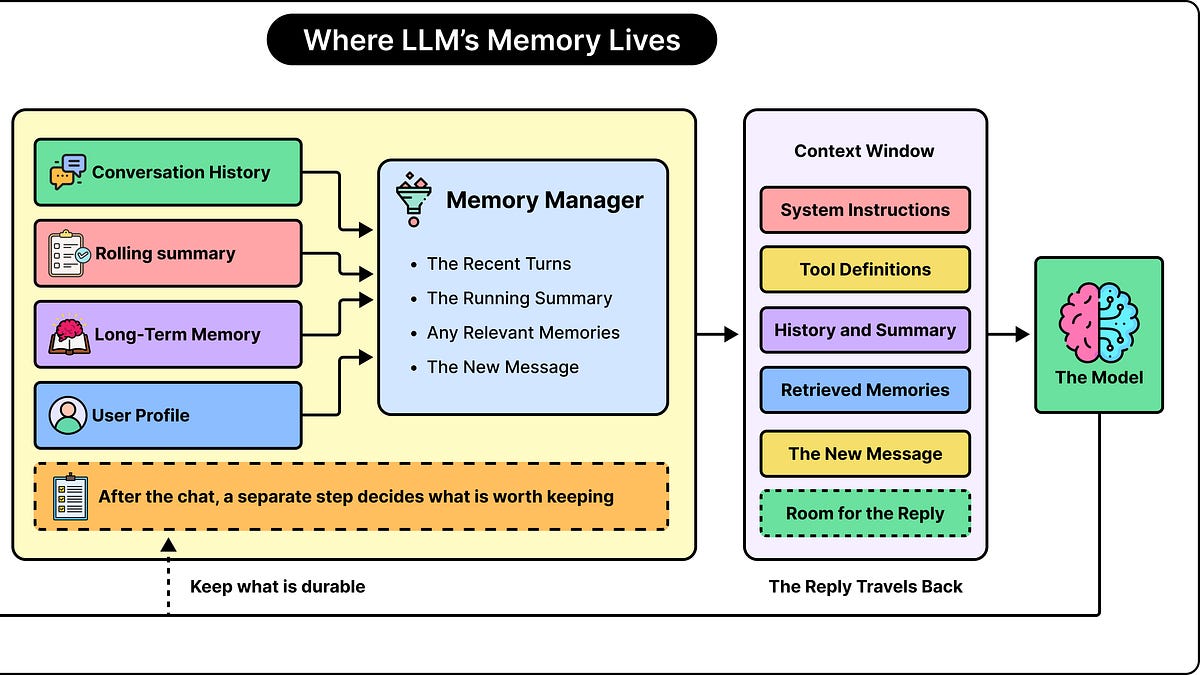
    The article explains that LLMs don’t have persistent personal memory; all “memory” is supplied by the surrounding application via the context window, summaries, or external storage. It outlines the distinction between trained weights, working‑memory (token context), and persistent application memory, shows how to construct API calls to preserve conversation state, and discusses the cost and laten…

    ByteByteGobytebytego.com12 min