proomt

Search

Search posts, papers, and topics

New

  1. Nvidia announces native GPU programming in Rust

    NVIDIA released CUDA‑Rust, letting you write GPU kernels directly in Rust and compile to PTX. Two programming models are supported: the traditional SIMT model via the `cuda-oxide` backend (nightly Rust, custom codegen) and the newer Tile model via `cutile‑rs` (stable Rust, JIT‑compiled Tile IR). Both provide Rust‑typed safety guarantees (e.g., `DisjointSlice`, tensor partitioning) and simple Carg…

    Hacker News front pagenvidia.com11 minHN961402
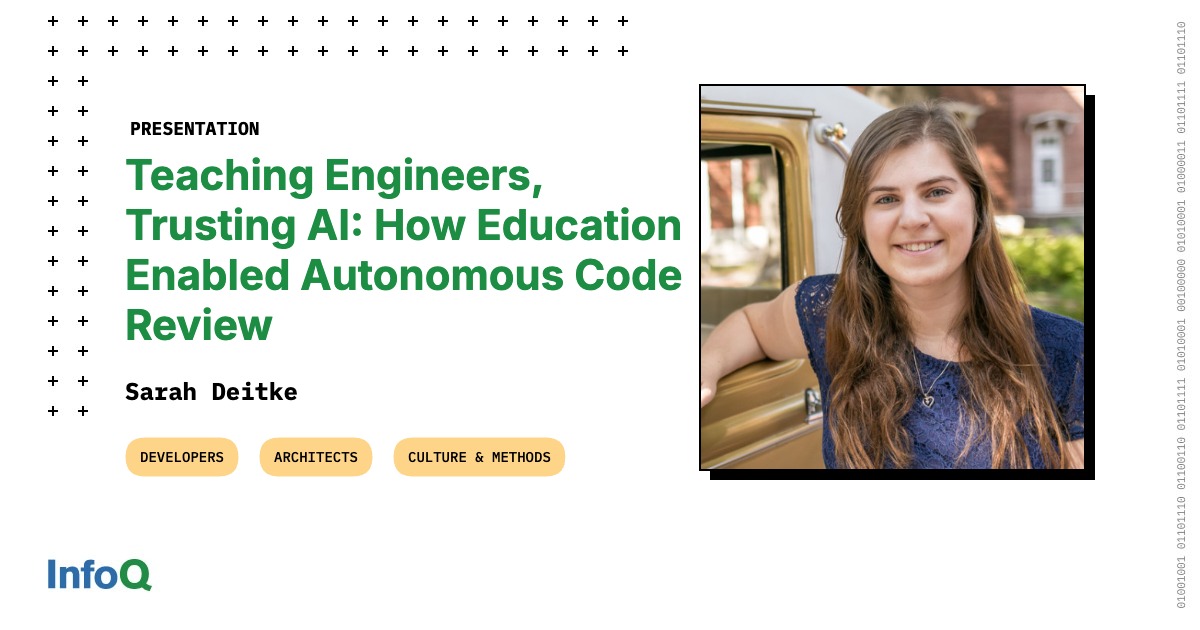
  2. Presentation: Teaching Engineers, Trusting AI: How Education Enabled Autonomous Code Review

    Duolingo’s DevEx AI team built a program of AI‑literacy workshops, observability dashboards, office‑hours, and vendor partnerships to get engineers comfortable with LLM‑based tools. With that foundation they launched a PR‑risk‑assessment bot that auto‑approves low‑risk pull requests, cutting review bottlenecks while keeping defect rates flat.

    InfoQinfoq.com24 mintalk
  3. Lyft Moves Streaming Fleet to Apache Flink Kubernetes Operator

    Lyft migrated its hundreds of production Flink jobs from a home‑grown Kubernetes operator to the Apache Flink Kubernetes Operator, gaining last‑state upgrades, in‑place autoscaling, and resource autotuning while cutting typical deployment downtime to 3–6 minutes. The switch also enabled Flink 1.19 features, saved millions in over‑provisioned capacity, and required workload‑specific scaling strate…

    InfoQinfoq.com3 min
  4. Article: Your Next DSL Author Is a Language Model

    Typed Domain Grounding (TDG) embeds a DSL inside a mainstream language the LLM already knows (e.g., Kotlin) and uses the host compiler as an oracle. The author describes five building blocks—embedding, choosing a host language with high training‑data frequency, compiler‑driven type safety, a generate‑compile‑repair loop, and an on‑demand teaching tool—and shows measured results from kUML, a Kotli…

    InfoQinfoq.com18 min
  5. Reinventing issue tracking: Local-first and Git-native

    A devlog describing how Manganin’s issue tracker stores issues in a dedicated Git repo as plain files, after rejecting earlier approaches that tried to embed issue data in the code tree or Git refs. The author explains the pitfalls of using refs for issue storage, shows the low‑level Git commands needed for that approach, and then outlines the final design: a hidden sister repository where each i…

    Lobstersmanganin.dev6 minHN1lobste.rs27
  6. Java 27 Delivers Post-Quantum Cryptography, Future Language Innovation, Helidon 27, JavaFX 27

    Java 27 ships with nine JEPs—G1 as the default GC, post‑quantum TLS 1.3, lazy constants, primitive‑type patterns, structured concurrency, compact object headers, JFR redaction, Vector API incubator, and PEM encoding preview—plus the first Java Verified Portfolio releases (Helidon 27, JavaFX 27, Jipher 20). The release is a security‑focused, non‑LTS update that paves the way for Project Valhalla f…

    InfoQinfoq.com5 min
  7. Your AI coding agent evaluation is only as good as its sandbox

    Evaluating AI coding agents requires a robust sandbox to prevent agents from retrieving answers from the environment, which can invalidate tests of internal knowledge. A correct answer doesn't guarantee a valid measurement if the agent accessed information it shouldn't have, highlighting the need to define sandboxes by information boundaries rather than just tool restrictions. Always review agent…

    Microsoft for Developersmicrosoft.com5 min
  8. 1 points

    MiniCPM5-2B Ranks First Among Open-Weight Models Under 4B

    MiniCPM5-2B, a 2.6 B‑parameter dense Llama‑style model, tops the Artificial Analysis GDPval‑AA v2 benchmark (831 Elo) and sits on the Pareto frontier of the Intelligence Index v4.2 despite being far smaller than competing models. The post breaks down its capability density, token‑cost efficiency, architecture, and three‑stage training (SFT, RL, on‑policy distillation) to explain why it outperform…

    SitePointsitepoint.com10 min
  9. CodeSOD: Extremely One Line

    The article spotlights a legacy ASP.NET page where the Page_PreInit method is crammed onto one line, mixing user‑agent sniffing and magic strings, illustrating how such code hurts readability and maintainability.

    The Daily WTFthedailywtf.com1 min
  10. Academic Doomerism

    Potts argues AI collapses the university's credentialing signal by cheapening essay and code production, and the author notes that degree devaluation started earlier via grade inflation. He suggests universities double down on human creativity and mentorship to stay relevant.

    Murat Demirbas (Metadata)blogspot.com5 minHN1
  11. University of Manchester Uses NVIDIA Earth-2 to Forecast Air Pollution Across the UK

    University of Manchester used NVIDIA Earth‑2 CorrDiff and StormCast generative models to downscale UK‑wide air‑pollution simulations. Training on the Isambard‑AI supercomputer (5,448 GH200 chips, 21 EFLOPS) took two days on an eight‑GPU node, producing a 2‑3 km resolution model. Inference runs on a desktop‑class DGX Spark, enabling rapid scenario forecasting and potential real‑time health alerts.…

    Nvidianvidia.com4 min
  12. Trusting-Trust Attack against an Entire Linux Distribution through Binary Manipulation

    The authors show that the classic trusting‑trust attack is not limited to compilers: by tampering with GNU strip they can inject a payload that propagates through NixOS's bootstrap and ends up in almost every binary of the final system. The attack succeeds on a real nixpkgs revision, building a full graphical installer while backdooring the majority of its binaries.

    arXiv cs.SE (Software Engineering)arxiv.org1 minpaperHN24159
  13. The top AI text generators in 2026

    Zapier’s 2026 roundup treats AI text generation as a ubiquitous feature rather than a standalone product. It explains that modern LLMs with long context windows have pushed dedicated generators into niche roles (marketing, SEO, agents) and then surveys the most useful built‑in generators across email (Gmail Gemini, Outlook Copilot), document suites (Google Docs, Microsoft Word, Notion), chatbots…

    Zapier Engineeringzapier.com9 min
  14. How to see who viewed your Google Doc

    A step‑by‑step guide to using Google Docs’ Activity dashboard to see who has opened a document, check sharing history, and control view‑history privacy, plus a brief note on automating notifications with Zapier.

    Zapier Engineeringzapier.com4 min
  15. Some things Veloren does differently

    Veloren’s engine uses a custom ECS, a novel ‘chonks’ voxel storage, full‑world pre‑generation, physically‑based erosion, and a scalable real‑time simulation (rtsim) that keeps tens of thousands of NPCs active, achieving ~50% CPU usage on a 48‑core server with 500+ players.

    Lobstersjsbarretto.com8 minHN5lobste.rs70