proomt

Search

Search posts, papers, and topics

Top

  1. 451

    GitHub Actions leaking secrets when Miri output is cached

    Miri writes all environment variables to the target/ directory, and when that directory is cached in GitHub Actions, secrets can be exposed to PRs. A short‑term patch now limits Miri to only preserve CARGO_* vars (excluding tokens) and OUT_DIR; until the fix lands, disable target caching or scope secrets away from Miri steps and clear existing caches.
    Rust Blogrust-lang.org3 minHN2
  2. 452

    Trajectory as the Teacher: Few-Step Discrete Flow Matching via Energy-Navigated Distillation

    Apple researchers propose Trajectory‑Shaped Discrete Flow Matching (TS‑DFM), a training‑time distillation method that replaces blind stochastic jumps in discrete flow‑matching with an energy‑based compass to select higher‑quality intermediate tokens. On a 170 M‑parameter language model, the 8‑step student outperforms the 1 024‑step teacher by 32 % perplexity while being 128× faster, beating basel…

    Apple Machine Learning Researchapple.com1 minpaper
  3. 453

    Refinement Is Inherently Editable: Training-Free Prompt-to-Prompt Image Editing with Generative Refinement Network

    RefineEdit is a training‑free framework that edits images by refining binary image codes through a generative refinement network, using probability differences to pick edit locations. It outperforms prior methods on background preservation and CLIP scores across nine editing categories without extra training or masks.

    Hugging Face Daily Papersarxiv.org1 minpaper
  4. 455

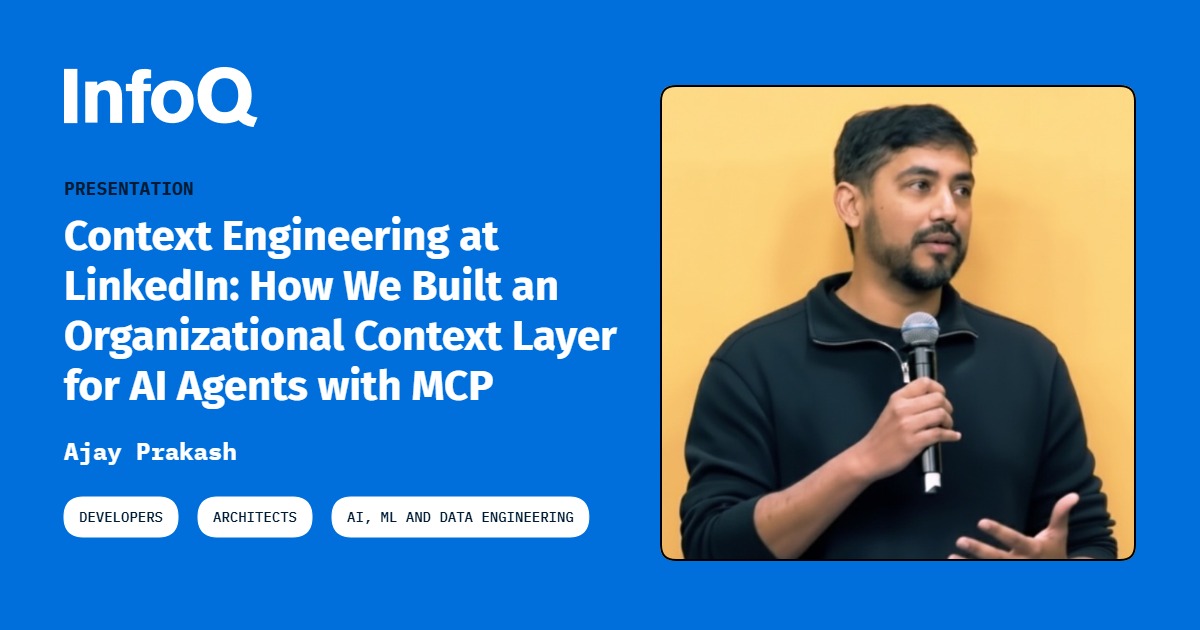
    Presentation: Context Engineering at LinkedIn: How We Built an Organizational Context Layer for AI Agents with MCP

    LinkedIn built a “Contextual Agent Playbooks and Tools” layer that wraps internal services (code search, docs, feature flags, etc.) behind the open‑source Model Context Protocol (MCP). By feeding LLM‑powered coding agents the exact internal artifacts they need, the agents can diagnose incidents, generate PRs, and update incident tickets in minutes, delivering a reported 20 % productivity gain wit…

    InfoQinfoq.com28 mintalk
  5. 456

    Open-Sourcing Rebalancer: A Generic, High-Performance Library for Solving Assignment Problems

    Meta open‑sourced Rebalancer, a library that lets engineers describe assignment problems (objects → bins) via a high‑level spec API, then solves them with either a MIP backend or a highly parallel local‑search engine. It handles millions of objects, solves ~40 M problems daily, and includes a debugging UI.

    Facebookfb.com8 minHN2
  6. 457

    REVERSAL-BENCH: A Reversibility Axis and Reset Oracle for Measuring the Reset-Free RL Cliff

    The paper presents REVERSAL‑BENCH, a benchmark that varies environment reversibility with a parameter ρ and provides a ground‑truth reset oracle for eight manipulation tasks. Using it, the authors show that reset‑free RL agents hit a sharp reversibility cliff and become permanently trapped, while episodic agents remain robust.

    Apple Machine Learning Researchapple.com1 minpaper
  7. 471

    Building Deterministic Multi-Agent State Machines in TypeScript

    The article shows how to build a deterministic, checkpoint‑backed finite state machine engine in TypeScript for orchestrating multi‑agent AI workflows. It uses Zod for schema validation, better‑sqlite3 for atomic persistence, and a pure transition function to make workflows traceable and recoverable in serverless environments.

    SitePointsitepoint.com18 min
  8. 474

    AI Skills with Matt Pocock

    Matt Pocock explains how he uses AI agents for software development, emphasizing "strategic programming" and guiding agents with "leading words" from classic engineering texts. He argues that this approach makes engineering fundamentals more critical than ever for creating agent-optimized codebases.

    The Pragmatic Engineerpragmaticengineer.com7 min
  9. 477

    Article: Your Next DSL Author Is a Language Model

    Typed Domain Grounding (TDG) embeds a DSL inside a mainstream language the LLM already knows (e.g., Kotlin) and uses the host compiler as an oracle. The author describes five building blocks—embedding, choosing a host language with high training‑data frequency, compiler‑driven type safety, a generate‑compile‑repair loop, and an on‑demand teaching tool—and shows measured results from kUML, a Kotli…

    InfoQinfoq.com18 min
  10. 478

    Glyph: A Multi-Strategy Agentic System for Column Description and Sensitivity-Ontology Tagging of Enterprise Data Catalogs

    Glyph is a production system that uses coordinated LLM agents and a fine‑tuned MiniLM encoder to automatically generate column descriptions and assign ontology tags in enterprise data catalogs. It combines code‑grounded retrieval, regex, and contrastive vector search, achieving NDCG@10 0.92 and MAP@100 0.90, and provides auditable provenance for each tag.

    Apple Machine Learning Researchapple.com1 minpaper
  11. 479
    1 points

    MiniCPM5-2B Ranks First Among Open-Weight Models Under 4B

    MiniCPM5-2B, a 2.6 B‑parameter dense Llama‑style model, tops the Artificial Analysis GDPval‑AA v2 benchmark (831 Elo) and sits on the Pareto frontier of the Intelligence Index v4.2 despite being far smaller than competing models. The post breaks down its capability density, token‑cost efficiency, architecture, and three‑stage training (SFT, RL, on‑policy distillation) to explain why it outperform…

    SitePointsitepoint.com10 min